

 Billing
 Inventory
 Online ordering
 Reporting
 Menu
Menu CRM
CRM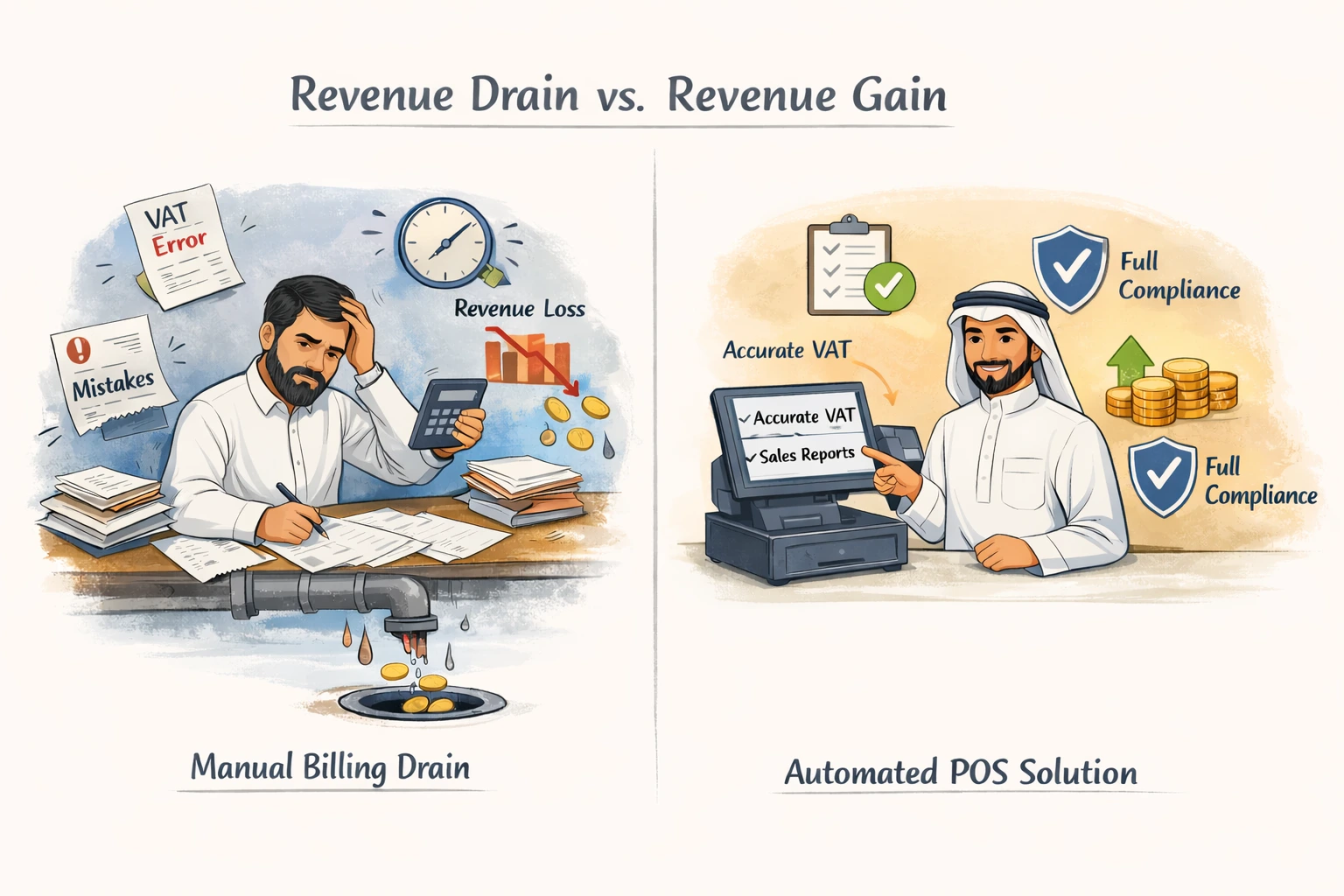
 Overseepos
 21 Feb 2026
While manual invoicing appears easy to perform at an inexpensive and cost-efficient level, the process can result in a “silent drain” of your company’s revenue due to excessive amounts of error, time consuming process and/or lost billing revenue. Many of the errors that accrue will be relatively small (e.g. a bill with an item missing or an inaccurate total due to incorrect calculation). The accumulation of these types of errors will eventually result in major financial loss.
While something may appear to be straightforward from afar, it's likely there are lost revenues, value added tax (VAT) miscalculations, compliance issues and wasted resources amongst your employees. The issue is not whether manual billing is effective; it’s whether it's equal to a slow leak of your profits.
Let's take a closer look.
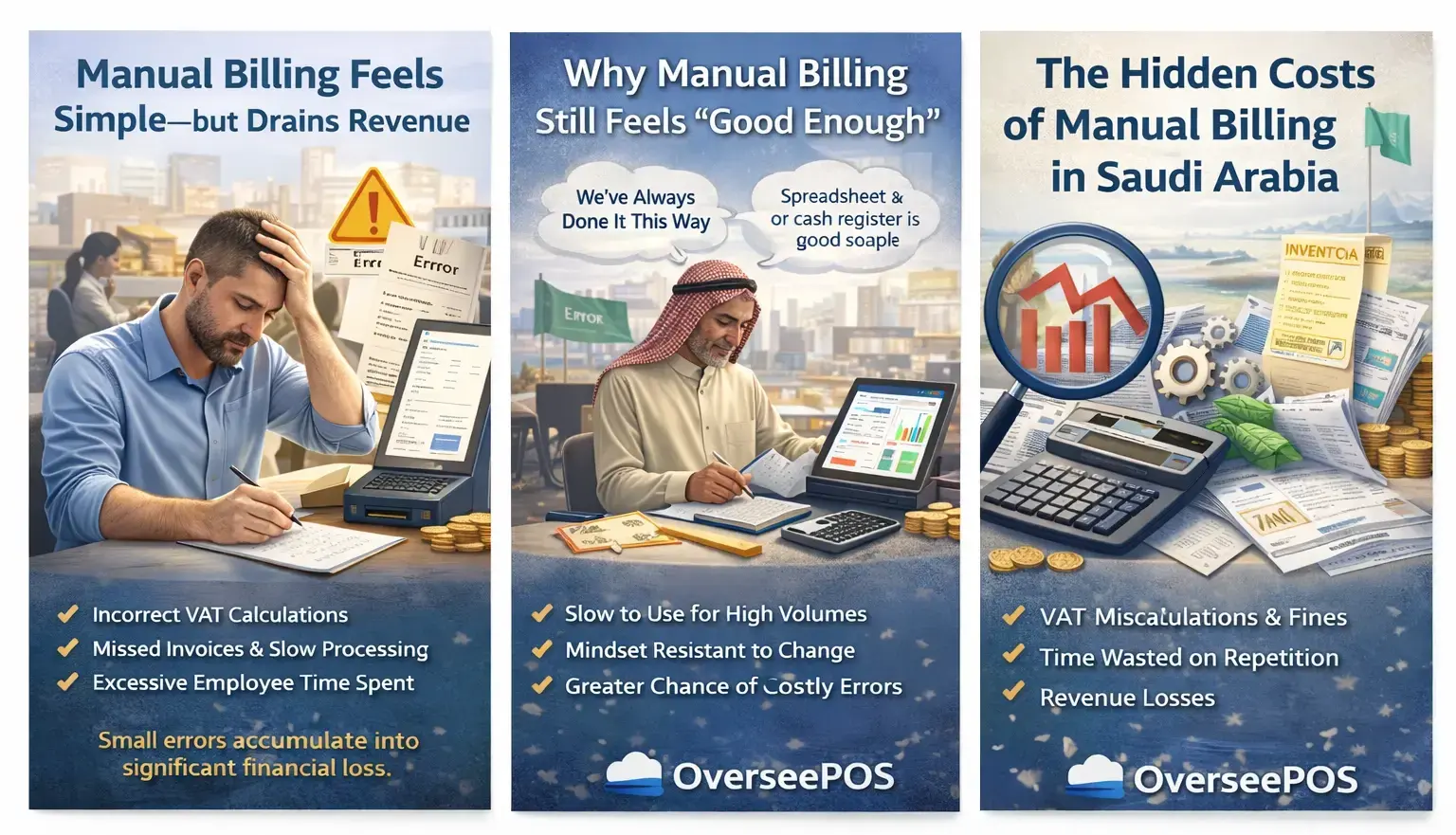
Why Manual Billing Still Feels “Good Enough”
Comfortable with Spreadsheets/Invoices
Some small retailers/service providers utilize items they are already comfortable using (notebooks, excel spreadsheets, simple cash registers, etc.). They are easy to begin using and do not require any new or complex technical setup.
However, slow to begin using will not be efficient when you have to track many transactions manually; as transaction volume increases you will find manual tracking becomes increasingly difficult and you will be building on small errors made early on.
“We’ve Always Done It This Way” Mindset
Companies often resist implementing a VAT-compliant POS system simply because, "We’ve always done it that way." If there haven't been any visible consequences to using manual invoices, it seems pointless to switch.
However, as regulations change, customers' expectations change, and competition continues to grow, the manual processes that have historically worked at similar businesses may now be a HUGE bottleneck.
Smaller retailers are frequently hesitant in their pursuit of automation because owner/operators:
- fear the complexity of the technology
- want to avoid large software costs
- are concerned with the cost associated with training staff
The cost of staying manual is often higher than the cost of switching.
The Disadvantages of Using a Manual Billing System in Saudi Arabia
1. Error in VAT Calculation and Punishment from ZATCA
The importance of VAT compliance in Saudi Arabia cannot be translated as a discretionary matter. The error rate due to manual calculation of VAT are potentially high; meaning it is highly likely that you will:
- Wrongly calculate the tax percentage
- Exclude VAT from an invoice
- Report on a mismatch
Errors have the potential of resulting in penalties, audits, negative publicity for your business.
A VAT-compliant POS removes the error of calculating VAT, lowering the possibility of penalty.
2. Revenue Loss due to Failure or Delay of Invoicing
There is an increase in the chance of:
- Invoicing someone/agency being forgotten about
- Undercharging clients
- Failing to track credit sales
All of these small errors can add up over time and create revenue loss for your company.
3. Staff Wasting Time Working on Repetitative Tasks
The time required to complete a manual billing system has substantial weekly costs, including:
- Producing invoices
- Re-calculating totals for each invoice
- Re-conciling daily sales summaries
- Cross-checking VAT amount
Those same employees could be selling, providing customer service, and contributing to the company.
4. Poor Financial Visibility
Manual systems typically do not track:
- Real-time total daily sales
- Top selling products per day
- Profit margins of each item
- VAT due on a monthly basis
Due to poor visibility, decisions will be made without having reliable information to make your decision truly objective.
5. Compliance and Audit Risks
Retrieving paper invoices and numerous spreadsheets is stressful and time consuming during an audit.
A uniformed, structured POS stores and organises all of your data securely within your point of sale system while producing reports as required.
Manual Billing vs VAT-Compliant POS Systems
Automated VAT Calculations with Accurate VAT Compliant POS Systems
VAT compliant POS provide:
- Proper application of correct VAT rates
- Properly formatted invoices
- Properly recorded VAT collected
- No guesswork or manual calculations
Synchronize Sales and Inventory in Real Time
Real time synchronization (with modern POS systems) includes updating:
- Sales reports
- Inventory levels
- Revenue summary reports
The Efficiency of Manual Billing Does Not Compare to Real Time Systems
Faster Checkout Experience
The need speed for your customers. A POS will allow you to:
- Reduce time in billing
- Accept a variety of payment types
- Provide an instant digital invoice or printed invoice
Manual billing or providing your customers with a timely checkout will slow down their journey.
Built-In Compliance & E-Invoicing Capabilities
It’s essential to remain complied with the Saudi ZATCA VAT compliance regulations throughout the future.
A POS that is VAT compliant will provide you with:
- Properly formatted invoices
- Secure transaction records
- Properly file tax
What is Right with a VAT Compliant POS System?
Eliminating handwritten invoice books
- Eliminating the need for manual VAT calculations
- Not needing to perform an end of day spreadsheet reconciliation
- Inventory guesswork will continue
- Revenue tracking will be 100% accurate with automated workflows, data is centralized
Key Benefits of Switching to VAT POS in Saudi
Improved Revenue Tracking
Understand clearly:
- Daily sales volume
- Weekly sales trends
- Monthly profits
Having accurate reports will allow you to make better decisions.
Reduced errors
Minimizing the chance for error through automation is especially important when dealing with:
- Sales tax calculation
- Pricing products
- Generating invoices
Better cash flow management
Monitoring unpaid invoices, payment methods and outstanding balances is very easy with a POS system.
Scalability for Growth
A POS system will grow with your business, allowing you to handle higher transaction volumes without any problems.
How To Choose The Right VAT Compliant POS In Saudi Arabia
Confirm ZATCA Compliance
Ensure the POS is currently compliant with Saudi regulations.
Check VAT Automation Features
Features to look for in a POS that automates VAT include:
- Tax calculations done automatically
- Detailed VAT reporting functionality
Have invoicing features that comply to VAT rules.
Assess Reporting and Inventory Functionality
Strong reporting features will enable you to:
- Identify top selling products
- Assess slow moving inventory
- Make informed purchasing decisions
Take Into Consideration The Total Cost Of Ownership
Comparing monthly subscription fees is not enough.
You will also want to evaluate fees for:
- Setup cost
- Hardware compatibility
- Support/maintenance costs
Why Are Retailers In Saudi Arabia Transitioning From Manual Billing To POS?
It is becoming increasingly apparent that:
- Regulations are forcing companies to be accurate in record keeping
- To remain competitive, companies must be efficient
- Customers expect faster service
- Companies require instant information for making decisions
Because of these factors, many retailers are transitioning from manual billing to POS.
Do Not Allow Your Profits to Be Reduced Due to Manual Billings
Manual billing is not only out of date, but bears its own associated risk.
The total of VAT (value-added tax) errors and uncollected revenue, along with wasted time on administrative activities and limited visibility, can quickly add up.
A POS system that is VAT-compliant will assist Saudi Arabian organisations with:
- Revenue protection
- Compliance
- Operational effectiveness
- Achieving growth
If you are still using manual processes, consider a reassessment of your business processes.
Automation will not replace your control over your process; rather, it will permit you the opportunity to have more control of it.
How Billing Software Can Streamline VAT Compliance in Saudi Arabia
Fast-paced restaurant environments make it vital that restaurants maintain price accuracy as well as adhere to VAT compliance requirements. Therefore, when restaurants are using manual billing methods, they risk having:
- Invoice & VAT calculation errors
- Missing information invoices
- Reporting inconsistencies
- ZATCA compliance violations
- Revenue loss from billing errors
All of these have the potential to result in government penalties & loss of revenue.
By implementing a Restaurant Billing System that is VAT compliant, restaurants will have:
- Automatic VAT calculation at checkout time
- Tax compliant invoices
- Structured and digitally maintained transaction records
- Securely stored data for audit readiness
- Real time VAT reports
With automated VAT handling, restaurant owners are no longer required to manually verify tax percentages or reconcile reports at the end of each day. Instead, the system automatically determines the VAT amount during checkout and reduces human errors, therefore increasing the accuracy of the reports and ensuring compliance with Saudi Arabia's standards.
Investing in a trustworthy restaurant billing software solution can provide food and beverage companies in Saudi Arabia with protection against financial loss due to operational streamlining, simplifying their compliance directly related to revenue generation and improving their overall efficiency.
Why Choose OverseePOS for POS Software?

OverseePOS is among the premier POS systems utilized globally by businesses all over the world, having already been used in multiple locations across Saudi Arabia (such as Riyadh, Jeddah, Dammam, and Khobar).
OverseePOS has an extremely configurable solution that can be used by ANY business in the restaurant and retail industries. Take your restaurant or retail businesses to the next level with an affordable, scalable solution that allows you to eliminate the use of spreadsheets and handwritten invoices. Automating your back-office operations via OverseePOS will enable your business to become more efficient, without making your operations complicated.
Why Choose OverseePOS?
With years of experience in the Saudi market, we understand the unique challenges faced by restaurant owners.
Whether you're running a small café or a large restaurant chain, OverseePOS can help you optimize your operations.